
Good to Know
lOCATION
upper mustang
TRIP TYPE
Trekking in Nepal
TRANSPORTATION
Fly and Drive
ARRIVAL ON
kathmandu
DEPARTURE FROM
kathmandu
Maximum Altitude:
3500m
GROUP SIZE
+1 PAX
ACCOMMODATION
Lodge
UPPER MUSTANG TREK
Forbidden Himalayan Kingdom
The Upper Mustang Trek is one of Nepal’s most extraordinary adventures—an expedition that transports travellers into a mystical world where time appears to stand still. Hidden within the rain shadow of the Himalayas, this restricted region—often celebrated as the “Last Forbidden Kingdom”—remained closed to the outside world until 1992. Today, it offers a rare chance to explore an ancient Tibetan-influenced culture, dramatic desert landscapes, and centuries-old cave civilisations untouched by modern development.
Why is Upper Mustang a Restricted Area in Nepal?
Upper Mustang, often referred to as the “Hidden Kingdom,” is one of Nepal’s most enchanting yet protected regions. Nestled in the rain-shadow of the Himalayas, this high-altitude desert captivates travellers with its stark landscapes, ancient monasteries, and preserved Tibetan culture. However, Upper Mustang is classified as a Restricted Area, and visiting it requires a special permit.
Journey to Lo Manthang for the Tiji Festival
There are two options to reach Lo Manthang for the Tiji Festival:
1: Drive from Pokhara
A scenic and adventurous journey through the Kali Gandaki Valley, passing terraced fields, apple orchards, and traditional villages. This is our recommended option as it allows you to enjoy the stunning landscapes at your own pace and is more reliable than flying.
2: Fly from Pokhara to Jomsom
A faster option, but flights can be unpredictable due to weather conditions, which may cause delays or cancellations.
For a smooth and memorable experience, we recommend the drive from Pokhara, combining comfort, reliability, and breathtaking views en route to Lo Manthang.
The designation as a restricted area stems from several key factors:
1: Cultural Preservation
Upper Mustang has a unique Tibetan-influenced culture that has remained largely untouched for centuries. The Nepalese government restricts access to protect this heritage from mass tourism and outside influences.
2: Environmental Protection
The region is ecologically fragile, with scarce water resources and delicate landscapes. Limiting the number of visitors helps minimise environmental degradation and preserve the pristine terrain.
3: Strategic Location
Upper Mustang borders Tibet (China) to the north, making it a sensitive geopolitical area. Controlled access ensures security and regulated interaction with foreign visitors.
Sustainable Tourism Management
The permit system allows authorities to monitor and manage tourism sustainably, providing employment for local guides and ensuring that the cultural and natural integrity of the region is maintained.
Exploring Upper Mustang offers a rare glimpse into a world that seems frozen in time, but it comes with responsibility. Travellers must respect local traditions, follow trekking regulations, and support the community that has safeguarded this hidden kingdom for generations.
A Land of Otherworldly Landscapes
Upper Mustang’s scenery feels unlike any other part of Nepal. The trek winds through a breathtaking tapestry of deep gorges, windswept cliffs, ochre-colored canyons, and vast barren plateaus sculpted by centuries of erosion. As you ascend deeper into the hidden kingdom, the snowy peaks of Annapurna and Dhaulagiri tower in the distance, adding a majestic contrast to the region’s stark desert beauty.
This surreal terrain—shaped by powerful winds and ancient rivers—gives Upper Mustang its reputation as Nepal’s very own “mini Tibet.”
A Living Museum of Tibetan Heritage
Culture is the true charm of Upper Mustang. Once a thriving trade corridor between Nepal and Tibet, the region still preserves its Tibetan Buddhist traditions, colourful festivals, and age-old customs.
Along the trail, you’ll encounter:
1: Centuries-old monasteries adorned with vibrant murals
2: Sacred sky caves are believed to date back thousands of years
3: Fortified villages standing proudly above the windswept valleys
4: Prayer walls, mani stones, and fluttering prayer flags guide trekkers from village to village
The journey culminates in Lo Manthang (3,840m)—the former walled capital of the Mustang Kingdom. This enchanting city of whitewashed houses, narrow alleys, and ancient temples offers a rare glimpse into a culture that has survived largely untouched for generations. Its Royal Palace, monasteries, local artisans, and humble hospitality make Lo Manthang a highlight of the entire expedition.
Trekking Route Highlights
The trek typically begins with a scenic flight from Pokhara to Jomsom, a quaint town nestled along the Kali Gandaki River. From there, the adventure unfolds on foot:
1: Kagbeni, Chele, and Syangboche
Picturesque villages offering warm hospitality and a peek into local customs.
2: Ancient Monasteries
Explore the spiritual centres of Ghar Gompa and Tsarang, each steeped in history and local legend.
3: Lo La Pass (3,950 m)
Cross this high pass for stunning panoramic views and the sense of stepping into a remote world.
4: Lo Manthang
The trek culminates here, where you can wander through the historic city, visit monasteries, and marvel at the surrounding Himalayan peaks.

Best Season for the Upper Mustang Trek
The Upper Mustang Trek is a journey into one of Nepal’s most mystical and remote regions. Timing your trek right can make a huge difference in both comfort and scenery.
Autumn | September to November
Autumn is widely regarded as the best season for trekking in Upper Mustang. During these months, the weather is stable, skies are clear, and temperatures are mild—perfect for long days on the trail. The landscape is vibrant, with stunning views of the surrounding mountains and colourful foliage in some areas.
Spring | April to May
Spring is another excellent time to explore Upper Mustang. As snow melts and vegetation blooms, the valleys and hillsides come alive with flowers and greenery. The weather is generally warm and pleasant, though occasional rain may appear at lower altitudes.
Monsoon | June to August
Although Upper Mustang lies in the rain shadow of the Annapurna and Dhaulagiri ranges, trekking during the monsoon is possible. Rainfall is minimal compared to other regions, but trails can be muddy, and sudden showers may occur.
Winter | December to February
Winter trekking in Upper Mustang is not recommended. Extremely cold temperatures, strong winds, and snow-covered paths make the trail risky. Many lodges and high passes may also be closed during this period.
Summary
For clear skies, comfortable temperatures, and breathtaking views, autumn and spring are the most popular and ideal seasons for the Upper Mustang trek.
Upper Mustang Trek Overview
The Upper Mustang Trek offers an unforgettable adventure, blending natural beauty with rich Tibetan-influenced culture. The trek’s duration, distance, daily walking hours, and difficulty can vary depending on your chosen itinerary, but here’s a general guide:
Duration
The trek usually takes 10-14 days, depending on your pace and itinerary. This includes trekking days, rest days, and time for exploring the region’s unique culture and landscapes.
Distance
Expect to cover around 120–150 km (75–93 miles) during the trek. Distances vary based on the specific route, side trips, and starting/ending points.
Daily Walking Hours
Trekking involves 5–7 hours of walking per day on average. Some days are shorter for acclimatisation or exploration, while other days may be longer, depending on the terrain and elevation gain.
Difficulty
The Upper Mustang Trek is considered moderate in difficulty. Trails are well-marked and do not involve high-altitude passes, but the trek demands good physical fitness and endurance. Hikers should be prepared for arid, rugged terrain with uphill and downhill sections, but technical climbing skills are not required.
Why Explore Upper Mustang?
With Adventure Fourteen Summit
Upper Mustang is a land of rugged beauty, ancient monasteries, and surreal desert landscapes—but navigating it requires experience, local knowledge, and proper permits. Adventure Fourteen Summit makes this journey seamless and unforgettable. Here’s why:
1: Expert Guidance and Local Knowledge
Our experienced guides know every trail, cliff, and hidden monastery in Upper Mustang. They ensure your trek is safe, culturally immersive, and enriched with fascinating stories of the region’s history and Tibetan Buddhist heritage.
2: Hassle-Free Permits and Logistics
As a Restricted Area, Upper Mustang requires special trekking permits. We handle all official documentation, transportation, and accommodations, so you can focus entirely on the adventure.
3: Authentic Cultural Experience
We connect you with local communities, monasteries, and traditional festivals, giving you an authentic glimpse into the “Last Forbidden Kingdom” while respecting local customs.
4: Customised and Comfortable Trekking
From carefully planned itineraries to high-quality food and lodging, Adventure Fourteen Summit ensures your trek combines adventure with comfort. Porters, guides, and staff support you every step of the way.
5: Safety in Remote Terrain
Upper Mustang’s rugged terrain and high altitude demand experienced support. Our team is trained for high-altitude trekking, emergency protocols, and acclimatisation strategies, giving you confidence and peace of mind.
With Adventure Fourteen Summit, Upper Mustang is not just a trek—it’s an unforgettable journey through one of Nepal’s most mysterious and enchanting regions, fully supported and expertly guided from start to finish.
UPPER MUSTANG TREKKING
 Meet Our Expert
TEMBA SHERPA
Meet Our Expert
TEMBA SHERPA
All Inclusive Price.
$
2500
Best
GuaranteeValue


Itinerary
representatives will welcome you outside the terminal hall. transferred to the hotel, briefed you about tomorrow’s activities, and collected any documents required by our office.
ACCOMODATION
3 star hotel
MAX ALTITUDE
1,350 m/4429 ft
MEALS
B/B
Introduce yourself to your trekking guide and receive a briefing about the upper Mustang trek each-day program. Trek leaders will check our trekking equipment to ensure that it is in good condition for our journey.
ACCOMODATION
3 Star hotel
MAX ALTITUDE
1,350 m/4429 ft
MEALS
B/B
Early in the morning, after breakfast, drive to Pokhara (200 km from Kathmandu; 6 hours by bus). Pokhara is one of the most visited cities after Kathmandu because of its scenic beauty. From the city, we get great views of the Himalayas, including Dhaulagiri, Manaslu, and Machhapuchhre, the five peaks of Annapurna. Pokhara is also a tourist destination, so we take some time out in the evening and enjoy ourselves!
ACCOMODATION
3 star hotel
MAX ALTITUDE
800 m
MEALS
B/B
An early morning flight to Jomsom, at 2750 m, reveals Jomsom to be a large, bustling settlement, and it is the administrative center of the region. It contains the airport, an army camp, and numerous hotels, shops, banks, and government offices. Continue walking from Jomsom to Eklai Bhatti at 2730 m. From here, we follow the trail along the river to Kagbeni at 2820 m which is situated at the junction of the Jhong Khola and the Kali Gandaki and is the northernmost village that can be visited without a permit to continue on to Mustang. This village fascinates us with its rich Tibetan culture and distinct hospitality, both of which significantly influence us.
ACCOMODATION
Lodge
MAX ALTITUDE
(2750 m)
MEALS
BLD
We reach Chaile from Kagbeni through Tangbe and Chhukong. The route from Kagbeni to Tangbe is straight up, so it can be done easily. Tangbe is a small village with a Tibetan majority, where you can find Mani walls and chortens. After Tangbe by walking straight down, you will reach Chhusang. On the opposite side of Chhusang, small caves can be seen easily. You can walk from Chhusang to Chaile by crossing the bridge and walking 20 minutes from the bridge.
ACCOMODATION
Lodge
MAX ALTITUDE
3050 m /10006 ft
MEALS
BLD
Today’s hike gets a little more difficult as we cross the Taklam La pass (3,624m) and the Darjori La pass (3,735m). But there are beautiful mountain views and interesting caverns along the route to distract us from our tired legs. The trail leads us down into Samar Village, where we go up a hill and down another steep trail to Syangmoche.
ACCOMODATION
Lodge
MAX ALTITUDE
3475 m /11400 ft
MEALS
BLD
Today there is another major pass to cross, the Yamada La, as well as chorten and lovely towns with barley fields to see. After trekking through the forest, we must cross another pass. The Nyi Pass is 4,010 meters high, but we descend to Ghami for the night. Ghami is a huge settlement for this area, nestled in a picturesque setting surrounded by farmland.
ACCOMODATION
Lodge
MAX ALTITUDE
3500 m/11482 ft
MEALS
BLD
the trek begins with a descent through rugged and often slick terrain to a suspension bridge over the Ghami Khola. The path leads us through mani walls (stone walls with Tibetan mantras engraved onto them) and across the Charang La Pass (3,870m). The settlement of Charang is located at the top of the Charang Chu Valley. To the east of this town stand a fortification and a blood-red gompa. After lunch, there will be plenty of time to explore!
ACCOMODATION
Lodge
MAX ALTITUDE
3560 m/11679 ft
MEALS
BLD
We descend into a canyon, cross a river, and rise to the Lo La Pass (3,950m). We get our first glimpse of the old and lovely settlement of Lo Manthang from the past. This walled village is the traditional residence of Lo’s King and is still the site of several unique and colorful Buddhist celebrations. the atmosphere of the location, the surrounding mountains – Nilgiri, Tilicho, Annapurna I, and Bhrikuti Peak)
ACCOMODATION
Lodge
MAX ALTITUDE
3770 m/12368 ft
MEALS
BLD
Today we’ll be exploring some of Upper Mustang’s mysteries. A short journey to Chhoser marks the start of an unforgettable day! The Jhong Caves, or perhaps Sky Caves, may be found here. These are five-story-high caverns constructed into rock faces. Researchers are still trying to figure out who created these caverns and why. It is thought that they were utilized as cave systems, hiding places, meditation sites, and, subsequently, monasteries. But no one knows where these incredible caverns came from. We may visit some of these caves while bringing a packed lunch to appreciate the ambiance of the caves, lunar-like environment, and mountains while also resting. Then we return to Lo Manthang for another overnight stay.
ACCOMODATION
Lodge
MAX ALTITUDE
(3770 m/12368 ft):
MEALS
BLD
After walking down from Lo-Manthang, you will reach Dantha. Then you must descend steeply before turning left and walking down the Kaligandaki River to arrive at Yara.
ACCOMODATION
Lodge
MAX ALTITUDE
3900 m
MEALS
BLD
Today is also a difficult and long day for us. Therefore, we start really early in the morning. We first have a short and steep ascent and then a long, flat trail. The trail then descends steeply to Dechhyang Khola. It takes about 30 minutes. Saligrams (black marine animal fossils) can be found all over the place. Then the trail steeply ascends and leads us to the top of the pass. From here, the trail goes up and down, and then we are on a huge plateau and cross it to reach Tangya village.
ACCOMODATION
Lodge
MAX ALTITUDE
3900m
MEALS
BLD
Today is also a long day again. Therefore, we start again really early in the morning. We leave the village, cross the suspension bridge, and follow the short river route. After crossing the river, we steeply climb up to reach a small pass. Then the trail goes straight to Paha. After the lunch break, we continue crossing many small passes until we reach the top of the hill. Then the trail steeply descends, and we encounter strong winds until we reach Tetang village. We have a superb view of Nilgiri Himal, Dhaulagiri I, Tukuche Peak, and other snow peaks during the trail.
ACCOMODATION
Lodge
MAX ALTITUDE
3040 m
MEALS
BLD
In the morning, after breakfast, we follow our trail through the village after passing the scenic Mani walls. Then, we keep ascending until reaching a small pass, from where we can see the high mountains and picturesque view of Muktinath. Then, we drop down to the small stream and cross on a suspension bridge. After that, we enter the village of Chhyongar and follow the level trail until reaching Muktinath, passing the Kani (gate). In the evening, in its compound, we explore the secret place for Hindus and Tibetan Buddhists for about 30 minutes. We can see the 108 brass water spouts and the Muktinath temple dedicated to Vishnu, a Hindu god. When we visit Muktinath Temple at the same time, we are liberated (saved) from the cycle of birth and rebirth. Below the temple is another Buddhist monastery, where the earth-water-fire combination contributes to Muktinath’s religious significance.
ACCOMODATION
Lodge
MAX ALTITUDE
3700 m
MEALS
BLD
In the morning, after breakfast, we leave the village and drop down to Jharkot village, where we visit the ancient Sakyamuni Buddhist Monastery and Traditional Medical Center. Then we follow the dusty road trail for a while before taking the shortcut left on the trail to Eklebatti. Following that, we take a dusty and steep road trail along the Kaligandaki River to Jomsom.
ACCOMODATION
Lodge
MAX ALTITUDE
2720 m
MEALS
BLD
After breakfast, we fly back to Pokhara, which takes approximately 20 minutes, and then transfer to our hotel in Pokhara. After lunch, we visit and hike around the valley. Stay overnight in a hotel.
ACCOMODATION
3 star hotel
MAX ALTITUDE
820 m
MEALS
B/B
We catch an early morning flight to Kathmandu after our long mountain journey. After reaching Kathmandu, we can take a rest or do some souvenir shopping. If we want to explore any other areas of Kathmandu, our guides can help with both souvenir shopping and sightseeing.
ACCOMODATION
3 Star hotel
MAX ALTITUDE
1350 m/4429 ft
MEALS
B/B
Generally, you need 3 hours before your flight time to get to the Kathmandu airport in Nepal. So you transfer to the Kathmandu airport for your flight to your destination.
ACCOMODATION
Lodge
MAX ALTITUDE
4200 m
MEALS
BLD
Cost Include
- Airport transfers (international & domestic) as per itinerary
- 2 nights Kathmandu hotel (twin sharing, BB)
- 2 nights Pokhara hotel (twin sharing, BB)
- Kathmandu–Pokhara–Kathmandu flights
- Pokhara–Jomsom–Pokhara flights
- Three daily meals during the trek (as per itinerary)
- Trekking accommodation in twin-sharing tea houses
- Annapurna Conservation Area Permit & TIMS card
- Upper Mustang Restricted Area Permit
- Licensed professional trekking guide
- Porters (1 porter for every 2 trekkers)
- Comprehensive medical kit
Cost Exclude
- International airfare to/from Nepal
- Nepal entry visa fees (15/30/90 days)
- Lunch & dinner in Kathmandu and Pokhara
- Travel insurance (medical, evacuation, loss, etc.)
- Beverages, alcohol, bottled/boiled water during trek
- Any meals or drinks not included in the itinerary
- Local monastery entrance fees in Mustang
- Extra hotel nights in Kathmandu due to early/late arrival or return
- Personal equipment & expenses
- Tips for staff
FIXED DEPARTURE DATE OF UPPER MUSTANG TREK
| Start | Finish | Availability | Price | |
|---|---|---|---|---|
| June 30, 2026 | Trip Status guaranteed | Starting from $ 2500 | Book Now | |
| September 3, 2026 | Trip Status available | Starting from $ 2500 | Book Now | |
| October 10, 2026 | Trip Status available | Starting from $ 2500 | Book Now | |
| November 19, 2026 | Trip Status available | Starting from $ 2500 | Book Now | |
| March 5, 2027 | Trip Status available | Starting from $ 2500 | Book Now | |
| April 17, 2027 | Trip Status available | Starting from $ 2500 | Book Now |
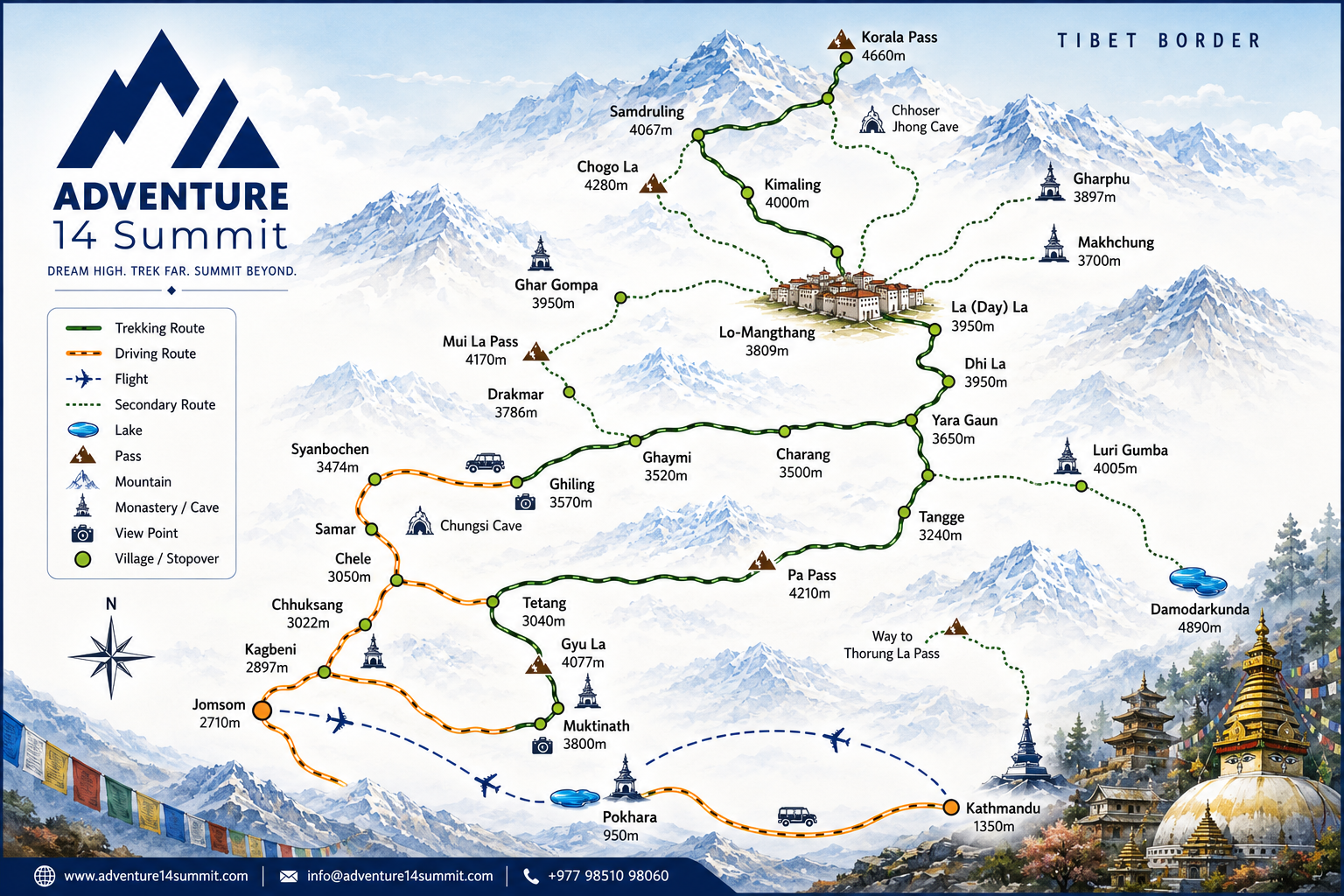
Map
Reviews
Meet Our Expert
TEMBA SHERPA
All Inclusive Price.
$
2500
Best
GuaranteeValue
𝗪𝗘'𝗗 𝗟𝗢𝗩𝗘 𝗧𝗢 𝗛𝗔𝗩𝗘 𝗔 𝗖𝗛𝗔𝗧
"𝗜𝗳 𝘆𝗼𝘂'𝗿𝗲 𝗶𝗻𝘁𝗲𝗿𝗲𝘀𝘁𝗲𝗱 𝗶𝗻 𝗱𝗶𝘀𝗰𝘂𝘀𝘀𝗶𝗻𝗴 𝘆𝗼𝘂𝗿 𝗻𝗲𝘅𝘁 𝗮𝗱𝘃𝗲𝗻𝘁𝘂𝗿𝗲, 𝗻𝗲𝗲𝗱 𝗮𝘀𝘀𝗶𝘀𝘁𝗮𝗻𝗰𝗲 𝘄𝗶𝘁𝗵 𝗽𝗹𝗮𝗻𝗻𝗶𝗻𝗴, 𝗼𝗿 𝘀𝗶𝗺𝗽𝗹𝘆 𝘄𝗮𝗻𝘁 𝘁𝗼 𝗵𝗮𝘃𝗲 𝗮 𝗰𝗵𝗮𝘁 𝗮𝗯𝗼𝘂𝘁 𝗮𝗻𝘆 𝘁𝗼𝗽𝗶𝗰, 𝗳𝗲𝗲𝗹 𝗳𝗿𝗲𝗲 𝘁𝗼 𝗮𝘀𝗸 𝗺𝗲 𝗮𝗻𝘆𝘁𝗵𝗶𝗻𝗴 𝗵𝗲𝗿𝗲. 𝗜'𝗺 𝗺𝗼𝗿𝗲 𝘁𝗵𝗮𝗻 𝗵𝗮𝗽𝗽𝘆 𝘁𝗼 𝗵𝗲𝗹𝗽 𝗶𝗻 𝗮𝗻𝘆 𝘄𝗮𝘆 𝗜 𝗰𝗮𝗻!"
+𝟵𝟳𝟳-𝟬𝟭𝟱𝟵𝟮𝟬𝟴𝟵𝟵 | +𝟵𝟳𝟳 𝟵𝟴𝟰𝟭𝟯𝟭𝟲𝟯𝟵𝟮
WANT TO CUSTOMIZE YPUR OWN TRIP
PLANNING A TRIP ?
"𝗪𝗲 𝗵𝗮𝘃𝗲 𝗮 𝘁𝗲𝗮𝗺 𝗼𝗳 𝗲𝘅𝗽𝗲𝗿𝗶𝗲𝗻𝗰𝗲𝗱 𝘁𝗿𝗮𝘃𝗲𝗹 𝗲𝘅𝗽𝗲𝗿𝘁𝘀 𝘄𝗵𝗼 𝗵𝗮𝘃𝗲 𝗯𝗲𝗲𝗻 𝘄𝗼𝗿𝗸𝗶𝗻𝗴 𝗶𝗻 𝘁𝗵𝗶𝘀 𝗶𝗻𝗱𝘂𝘀𝘁𝗿𝘆 𝗳𝗼𝗿 𝗼𝘃𝗲𝗿 𝗮 𝗱𝗲𝗰𝗮𝗱𝗲. 𝗙𝗲𝗲𝗹 𝗳𝗿𝗲𝗲 𝘁𝗼 𝗰𝗼𝗻𝘀𝘂𝗹𝘁 𝘄𝗶𝘁𝗵 𝘂𝘀 𝘁𝗼 𝗴𝗲𝘁 𝘀𝘁𝗮𝗿𝘁𝗲𝗱 𝗼𝗻 𝘆𝗼𝘂𝗿 𝗻𝗲𝘅𝘁 𝗮𝗱𝘃𝗲𝗻𝘁𝘂𝗿𝗲!"


© Copyright Adventure 14 Summit Expedition.