
Good to Know
lOCATION
Annapurna Region
TRIP TYPE
Expeditions
TRANSPORTATION
Flight and Drive
ARRIVAL ON
kathmandu
DEPARTURE FROM
Kathmandu
Maximum Altitude:
7128M
GROUP SIZE
+1
ACCOMMODATION
Lodge and Tent
HIMLUNG HIMAL SKI EXPEDITION
The colossal massif of Himlung Himal, towering at 7,126 meters in Nepal’s Manaslu region, presents a unique proposition for seasoned skiers: a challenging yet rewarding ski expedition experience. Unlike its heavily frequented Himalayan counterparts, Himlung Himal offers a pristine and remote adventure, demanding exceptional technical skill and a deep respect for the mountain’s formidable nature. Located in the Peri Himal range, near the border with Tibet, Himlung Himal is less frequented compared to other Himalayan giants, providing an unspoiled and serene environment for an expedition. The mountain’s broad, snow-covered slopes and consistent snow conditions make it an ideal candidate for skiing, despite the challenges posed by its high altitude and remote location.
A Peak for the Accomplished: The Challenge of Himlung Himal:
Towering at an impressive 7,126 meters within Nepal’s Manaslu region, Himlung Himal is recognized as one of the more accessible 7,000-meter peaks for skiers possessing the requisite technical skillset. However, make no mistake, this expedition is a true test of expertise. It demands a high level of proficiency in both skiing and mountaineering, along with demonstrably successful experience at high altitude. The unforgiving environment necessitates a deep understanding of mountain craft, including rope work, crevasse rescue, and the ability to make sound decisions in challenging conditions.
A Journey of Acclimatization and Skill Development: Preparing for the Summit Push:
The Himlung Himal Ski Expedition is meticulously planned to maximize your chances of summit success while prioritizing safety throughout the journey. Our program commences with a trek to base camp, established at approximately 4,900 meters. This initial phase allows for crucial acclimatization, a process where your body gradually adapts to the thinning air and harsher conditions at high altitudes. To ensure optimal physiological adjustments, climbers will undertake a series of strategically planned rotations. These rotations involve gradual ascents and descents of the mountain, progressively exposing you to the demands of the higher camps and allowing your body to build the strength and endurance necessary for summit day.
Summit Day and Beyond: Earning Your Turns on Pristine Himalayan Slopes:
The summit push itself is a meticulously orchestrated two-day endeavor. Skiers will establish a high camp for the night before embarking on a pre-dawn ascent to the peak. Summit day will be a grueling yet rewarding experience, testing your physical and mental fortitude. However, the unparalleled reward awaits at the top. Imagine standing atop this majestic peak, gazing out at a breathtaking panorama of the Himalayas stretching out before you.
The descent from the summit offers an extended and demanding ski route, a true test of your technical prowess on a long and challenging slope. However, the unparalleled rewards far outweigh the challenge. Imagine the thrill of conquering a formidable peak, followed by the exhilarating freedom of carving your tracks through some of the most pristine and untouched terrain the Himalayas have to offer. As you descend, be captivated by breathtaking panoramas of the surrounding Himalayan giants, a sight that will forever be etched in your memory.
when is the best season for Skiing in the Himlung Himals?
The Himlung Himal expedition is a popular mountaineering destination located in the Nepal Himalayas. The best time to go skiing in the Himlung Himal region is typical during the spring season (April to May) and the autumn season (October to November). These periods offer stable weather conditions, clear skies, and relatively lower avalanche risks, making them ideal for skiing.
Spring Season |April to May: During spring, the temperatures start to warm up, and the snowpack becomes more stable after the winter season. This season is known for its longer daylight hours, which allows for extended skiing opportunities. The snow conditions are usually firmer in the mornings, becoming softer and more enjoyable as the day progresses.
Autumn Season | October to November: Autumn is another great time for skiing in the Himlung Himal region. The weather tends to be stable, with clear skies and mild temperatures during the day. The snowpack is usually well-settled after the monsoon season, providing good skiing conditions. Additionally, the autumn season offers breathtaking views of the surrounding mountains as the skies tend to be clearer.
It’s important to note that weather conditions can vary, and it’s always advisable to check with local authorities or experienced mountaineering guides for the most up-to-date information before planning your skiing expedition in the Himlung Himal region.
HIMLUNG HIMAL | 7126M
Duration: The typical duration for a Himlung Himal expedition is around 20-25 days. This timeframe includes arrival and departure days in Kathmandu, as well as trekking to the base camp, acclimatization, summit push, and return to the base camp.
Distance: The distance covered during the expedition will depend on the specific route taken. The most common approach is to start from Koto or Dharapani, which are reached after a drive from Kathmandu to Besisahar, followed by a trek along the Annapurna Circuit trail. The trekking distance from Koto or Dharapani to the Himlung Himal base camp is approximately 60-70 kilometers (37-43 miles) one way.
Camp Duration and Distance: The number of camps and the time required from each camp can vary depending on the climbing team’s pace and acclimatization schedule. Here’s a general breakdown of the camps and the approximate time required:
Base Camp | 4,900 meters |16,076 feet: This is the starting point for the climb. From the base camp, there will be multiple rotations and acclimatization climb to higher camps.
Camp 1 | 5,700 meters |18,701 feet: This camp is usually established on a moraine plateau above the base camp. The time required to reach Camp 1 from the base camp is around 4-6 hours.
Camp 2 | 6,400 meters | 21,000 feet: Camp 2 is typically set up above a large plateau and requires crossing a steep slope. The time required to reach Camp 2 from Camp 1 is approximately 4-6 hours.
Camp 3 | 6,900 meters | 22,637 feet: Camp 3 is usually established near the shoulder of the mountain. The time required to reach Camp 3 from Camp 2 is around 3-5 hours.
Summit Push: From Camp 3, the summit push begins. The ascent from Camp 3 to the summit can take around 7-10 hours, depending on the climbers’ pace and conditions.
Difficulty: Himlung Himal is considered a technically challenging peak, but its difficulty level is generally categorized as moderate to difficult. It requires good mountaineering skills, experience in high-altitude climbing, and familiarity with glacier travel. The steep slopes, icy terrain, potential rockfall, and unpredictable weather conditions add to the challenge. Proper acclimatization, physical fitness, and technical competence are crucial for a successful summit bid.
Join Adventure 14 Summits on the Himlung Himal Ski Expedition and embark on a journey that will redefine your perception of adventure. This professionally guided expedition is designed for experienced skiers seeking an extraordinary challenge. Contact Adventure 14 Summits today to secure your place on this unforgettable expedition.
SKIING IN HIMLUNG HIMAL (7127M)
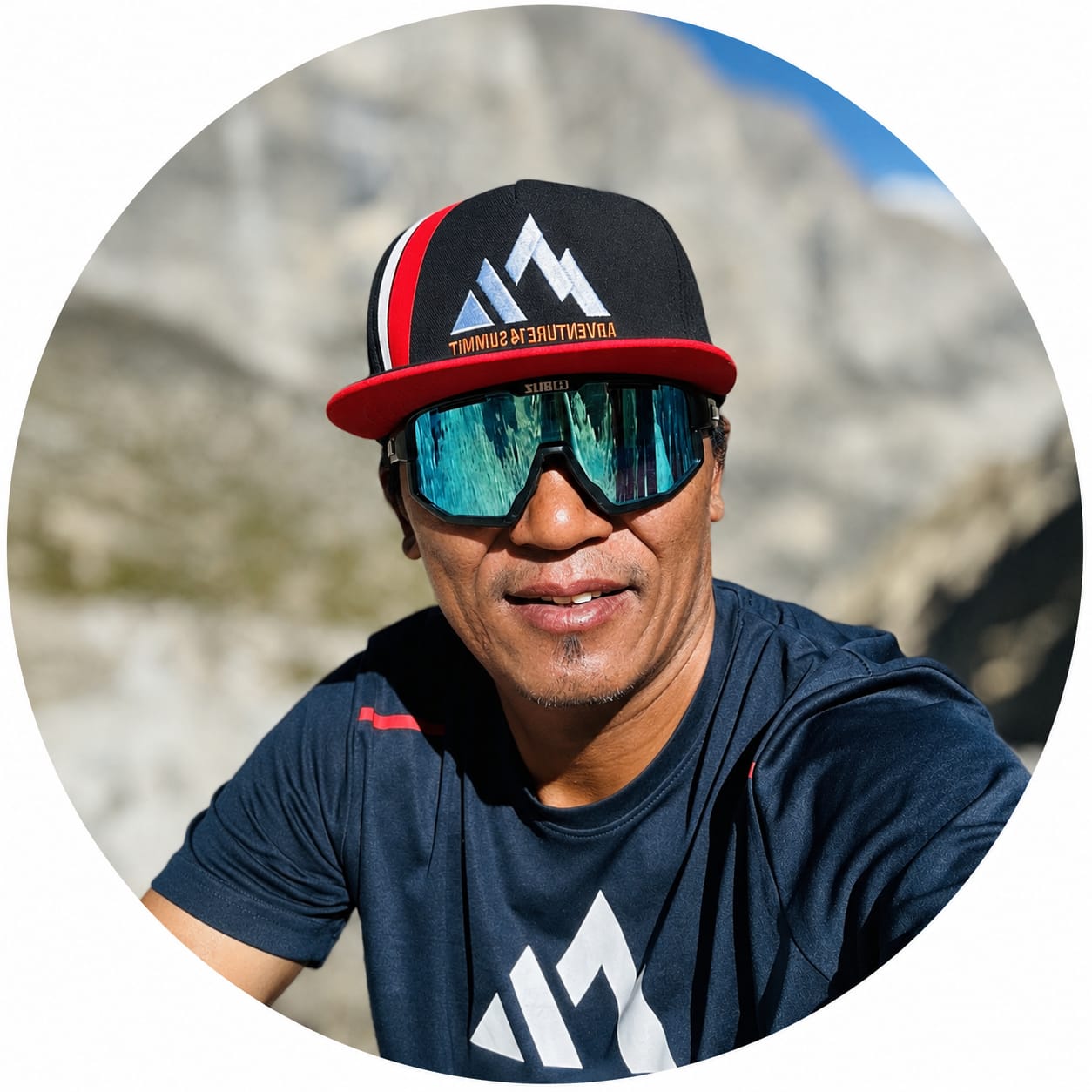 Meet Our Expert
TEMBA SHERPA
Meet Our Expert
TEMBA SHERPA
All Inclusive Price.
$
7500
Best
GuaranteeValue


Itinerary
You must follow a few formal requirements when you arrive, At the Tribhuvan International Airport, go to the immigration office to get your Nepal entry visa.
Our office representatives will welcome you outside the terminal hall and transfer you to the hotel. brief you about tomorrow’s activities and collect any documents required by our office.
ACCOMODATION
4 star hotel
MAX ALTITUDE
1,350 m
MEALS
B/B
On the second day, we will complete all of our formalities, such as getting the required paperwork, permits, and other formalities required for our expedition, and we will begin making preparations for it. We will now prepare our luggage, go shopping, and double-check everything we need (especially medicines and essentials). There will be briefings on every part of the expedition, including all gear and equipment, the length of the trip, lodging options, base camp facilities, and all other aspects related to the expedition. It also gives you the chance to interact with and get to know your climbing companions and colleagues.
ACCOMODATION
4 Star hotel
MAX ALTITUDE
1,350 m
MEALS
B/B
Driving along the Kathmandu-Pokhara Highway to Dumre and then following the rough route by the Marsyangdi River, we pass through the low-lying villages and rice fields. After an 8-hour drive, we finally reach Besi Sahar. Besi Sahar is the capital of Lamjung District.
ACCOMODATION
Lodge
MAX ALTITUDE
800 m/2,624 ft
MEALS
BLD
We will take a Jeep drive-through off-road to Koto. We will pass through many beautiful villages along the road. Koto village is the junction point where we leave the Annapurna Circuit Trekking Trail and follow the Nar Phu Trekking Trail.
ACCOMODATION
Lodge
MAX ALTITUDE
2,675 m/8,774 ft
MEALS
BLD
We register our restricted area permit at the police checkpoint. Then we walk to the Soti Khola riverbank, passing through lovely pine trees, little cave shelters, and pilgrim resting sites. We next continue our journey through the woods, ascending steeply towards the Meta settlement.
ACCOMODATION
4 Star hotel
MAX ALTITUDE
3,560 m/11,680 ft
MEALS
BLD
We start our day traversing up and down through some of the unique, colorful Tibetan Buddhist chortens and crossing suspension bridges over different rivers. We arrive in Kyang after 4 hours of walking, where we can see where Khampa refugees from Tibet were once captured and lived. Just before crossing the bridge into Phu, a line of wonderful chortens colors the landscape. You continue on a rocky trail after crossing the Phu Khola bridge until you reach Phu village.
ACCOMODATION
Tent
MAX ALTITUDE
4,250 m/13,944 ft
MEALS
BLD
It’s good to spend an acclimatization day in Phu. We have suggested resting and getting acclimatized to the altitude. Hike up to Himlung Himal base camp. Explore the culture, natural diversity, and religious practices of the ethnic groups. Explore the Tashi Lakhang Monastery, the oldest Buddhist monastery listed among the world’s 108 great Buddhist monasteries, and the last monastery built by Karmapa Rinpoche. During the acclimatization, we can observe how people make their living depending on agriculture, animal breeding, and seasonal migrations in such remote locations or in the hidden valley.
ACCOMODATION
Tent
MAX ALTITUDE
4250 m/13944 ft
MEALS
BLD
We hike towards the east through a glacial valley leading to the Himlung Himal base camp. a great place for camping and setting up our base camp. The mountain views are tremendous!
ACCOMODATION
Tent
MAX ALTITUDE
4250 m/13944 ft
MEALS
BLD
We spend several nights at base camp for proper acclimatisation before we head to the higher camps. We will do one rotation climb up to Camp III before pushing for the summit of Himlung Himal. We organise climbing training covering climbing techniques, glacier travel, safety techniques, abseiling, belaying, and the use of oxygen, a mask, and a regulator.
ACCOMODATION
Tent
MAX ALTITUDE
4250 m/13944 ft
MEALS
B/B
It is not a difficult climb to Camp 1. Before arriving at Camp 1, climbers must traverse the glaciers, ascent the moraines, and climb the narrow valleys. The risk of avalanches is low on the route.
ACCOMODATION
Tent
MAX ALTITUDE
5450 m/17552 ft
MEALS
BLD
The walk from Camp 1 to Camp 2 is along an elevated scree slope that leads to the glacier’s edge. This section may be the most challenging of the climb, depending on the time of year and the snowpack. We ascend the glacier further, crossing a few crevasses. The rope-fixing team will set the fixed rope on the steeper and more exposed section of the course. We will next approach Camp III after several days of preparation. return to Camp II after touching Camp III. These will help you improve your climbing tool and gear skills.
ACCOMODATION
Tent
MAX ALTITUDE
6200 m/20341 ft
MEALS
BLD
After long hikes and climbs, our bodies need to recover. We will thus descend to the Base Camp, which is at a considerably lower height, after spending the night in Camp II. We use these ascents and descents to acclimatize to the Himalayas and prepare to ascend the summit of Himlung Himal.
After a few days of rest in the base camp, our expedition guides will check the weather and choose the best time to undertake the final summit push.
ACCOMODATION
Tent
MAX ALTITUDE
4900 m/16,076 ft
MEALS
BLD
The walk from Camp 1 to Camp 2 is along an elevated scree slope that leads to the glacier’s edge. We ascend the glacier further, crossing a few crevasses. The rope-fixing team will set the fixed rope on the steeper and more exposed section of the course.
ACCOMODATION
Tent
MAX ALTITUDE
6200 m/20341 ft
MEALS
BLD
Expect the summit push day to be the longest and most challenging. The steepest climb of the summit push begins, a 45–50° vertical climb gaining 1100 meters in altitude. This final part of the climb is a straightforward but physically and mentally demanding uphill battle. After the summit, we will descend to Camp 1.
ACCOMODATION
Tent
MAX ALTITUDE
7126 m/23379 ft
MEALS
Lodge
The following day, we will head to Base Camp, pack all our gear, celebrate our summit success, have a more joyous night, and prepare for the journey back to Kathmandu
ACCOMODATION
Tent
MAX ALTITUDE
4900 m/16,076 ft
MEALS
Lodge
We make our way back to the lovely Phu village. After the experience of climbing a 7,000 meter mountain and all the experiences along the way, we came away with many memories.
ACCOMODATION
Tent
MAX ALTITUDE
4,050 m/13,284 feet
MEALS
BLD
We return to Meta by the same route. We’ll be descending for the most part, so it’ll be faster than before.
ACCOMODATION
Tent
MAX ALTITUDE
3,560 m/11,678 ft
MEALS
BLD
After breakfast in Besisahar, we will drive back to Kathmandu, which is roughly a 6–7 hour drive depending on the road and traffic conditions on the main highway. On arrival in Kathmandu, we will be transferred to a hotel, where we will rest for the evening.
ACCOMODATION
Lodge
MAX ALTITUDE
1,300 m/4,265 ft
MEALS
BLD
Generally, you need 3 hours before your flight time to get to the Kathmandu airport in Nepal. So, you transfer to the Kathmandu airport for your flight to your destination.
SKIING IN HIMLUNG HIMAL (7127M)
FIXED DEPARTURE OF SKIING IN HIMLUNG HIMAL (7127M)
| Start | Finish | Availability | Price | |
|---|---|---|---|---|
| September 2, 2026 | Trip Status available | Starting from $ 7500 | Book Now | |
| October 16, 2026 | Trip Status available | Starting from $ 7500 | Book Now | |
| November 19, 2026 | Trip Status available | Starting from $ 7500 | Book Now | |
| March 2, 2027 | Trip Status available | Starting from $ 7500 | Book Now | |
| April 21, 2027 | Trip Status available | Starting from $ 7500 | Book Now |
Map

Reviews
Meet Our Expert
TEMBA SHERPA
All Inclusive Price.
$
7500
Best
GuaranteeValue
𝗪𝗘'𝗗 𝗟𝗢𝗩𝗘 𝗧𝗢 𝗛𝗔𝗩𝗘 𝗔 𝗖𝗛𝗔𝗧
"𝗜𝗳 𝘆𝗼𝘂'𝗿𝗲 𝗶𝗻𝘁𝗲𝗿𝗲𝘀𝘁𝗲𝗱 𝗶𝗻 𝗱𝗶𝘀𝗰𝘂𝘀𝘀𝗶𝗻𝗴 𝘆𝗼𝘂𝗿 𝗻𝗲𝘅𝘁 𝗮𝗱𝘃𝗲𝗻𝘁𝘂𝗿𝗲, 𝗻𝗲𝗲𝗱 𝗮𝘀𝘀𝗶𝘀𝘁𝗮𝗻𝗰𝗲 𝘄𝗶𝘁𝗵 𝗽𝗹𝗮𝗻𝗻𝗶𝗻𝗴, 𝗼𝗿 𝘀𝗶𝗺𝗽𝗹𝘆 𝘄𝗮𝗻𝘁 𝘁𝗼 𝗵𝗮𝘃𝗲 𝗮 𝗰𝗵𝗮𝘁 𝗮𝗯𝗼𝘂𝘁 𝗮𝗻𝘆 𝘁𝗼𝗽𝗶𝗰, 𝗳𝗲𝗲𝗹 𝗳𝗿𝗲𝗲 𝘁𝗼 𝗮𝘀𝗸 𝗺𝗲 𝗮𝗻𝘆𝘁𝗵𝗶𝗻𝗴 𝗵𝗲𝗿𝗲. 𝗜'𝗺 𝗺𝗼𝗿𝗲 𝘁𝗵𝗮𝗻 𝗵𝗮𝗽𝗽𝘆 𝘁𝗼 𝗵𝗲𝗹𝗽 𝗶𝗻 𝗮𝗻𝘆 𝘄𝗮𝘆 𝗜 𝗰𝗮𝗻!"
+𝟵𝟳𝟳-𝟬𝟭𝟱𝟵𝟮𝟬𝟴𝟵𝟵 | +𝟵𝟳𝟳 𝟵𝟴𝟰𝟭𝟯𝟭𝟲𝟯𝟵𝟮
WANT TO CUSTOMIZE YPUR OWN TRIP
PLANNING A TRIP ?
"𝗪𝗲 𝗵𝗮𝘃𝗲 𝗮 𝘁𝗲𝗮𝗺 𝗼𝗳 𝗲𝘅𝗽𝗲𝗿𝗶𝗲𝗻𝗰𝗲𝗱 𝘁𝗿𝗮𝘃𝗲𝗹 𝗲𝘅𝗽𝗲𝗿𝘁𝘀 𝘄𝗵𝗼 𝗵𝗮𝘃𝗲 𝗯𝗲𝗲𝗻 𝘄𝗼𝗿𝗸𝗶𝗻𝗴 𝗶𝗻 𝘁𝗵𝗶𝘀 𝗶𝗻𝗱𝘂𝘀𝘁𝗿𝘆 𝗳𝗼𝗿 𝗼𝘃𝗲𝗿 𝗮 𝗱𝗲𝗰𝗮𝗱𝗲. 𝗙𝗲𝗲𝗹 𝗳𝗿𝗲𝗲 𝘁𝗼 𝗰𝗼𝗻𝘀𝘂𝗹𝘁 𝘄𝗶𝘁𝗵 𝘂𝘀 𝘁𝗼 𝗴𝗲𝘁 𝘀𝘁𝗮𝗿𝘁𝗲𝗱 𝗼𝗻 𝘆𝗼𝘂𝗿 𝗻𝗲𝘅𝘁 𝗮𝗱𝘃𝗲𝗻𝘁𝘂𝗿𝗲!"


© Copyright Adventure 14 Summit Expedition.